 Beatline
Binaural beats app
Two steady tones, and the difference between them
Beatline generates binaural beats live on your iPhone, at the frequency printed on screen. The number you see is the number you hear.
- Binaural frequencies have a medium-sized effect on anxiety, attention and memory across 22 studies. We publish the ones that disagree too
- No free trial, so nothing starts charging you later. No account, no analytics, no advertising
- Free download. Four sounds are free forever, one each for sleep, focus, calm and nature
 Download now for free
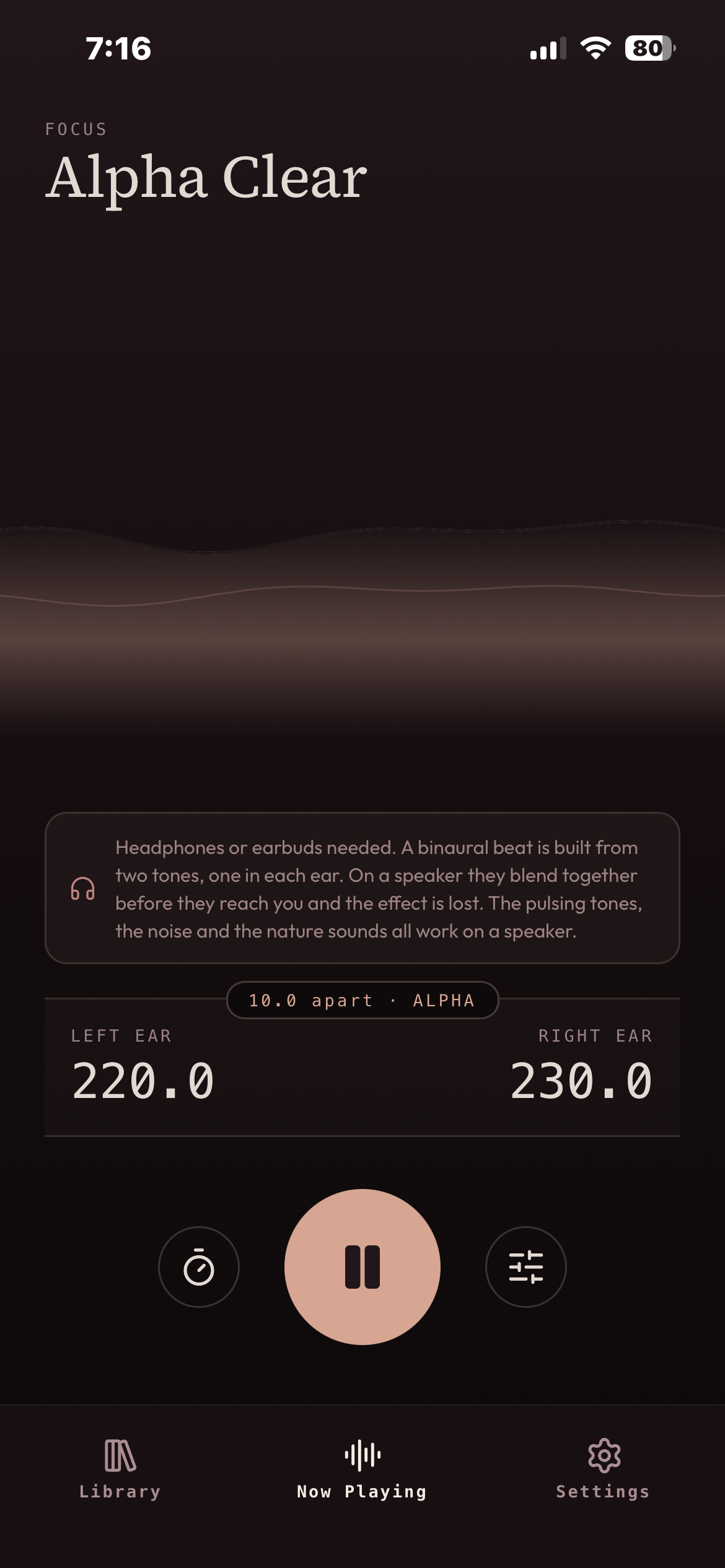
Where the two tones line up the sound swells; where they oppose each other it thins. That rise and fall, four times a second, is the beat. Neither tone pulses on its own, which is why headphones matter and why both numbers stay on screen.
What it does
-
Every tone generated on the device
Nothing streams. The binaural beats, isochronic pulses, pure tones and all seven noise colours are synthesised as you listen, which is why the app can show you the exact frequency it is producing.
-
The numbers, always
Left ear, right ear, and the difference between them. Locked sounds show theirs too, because a frequency is not the thing you are being sold.
-
Set your own beat
Move the beat anywhere in the range and the readout follows. Drift away from a preset and the app says so, and offers you the way back.
-
Sounds that work on a speaker
A binaural beat needs headphones, and the app tells you when yours are not connected. Pulsing tones, noise and the nature recordings work either way.
-
Sleep timer with a real fade
An abrupt cut to silence wakes people, so the last two minutes fade out. Fifteen minutes to eight hours, or until you stop it.
-
Built for a dark room
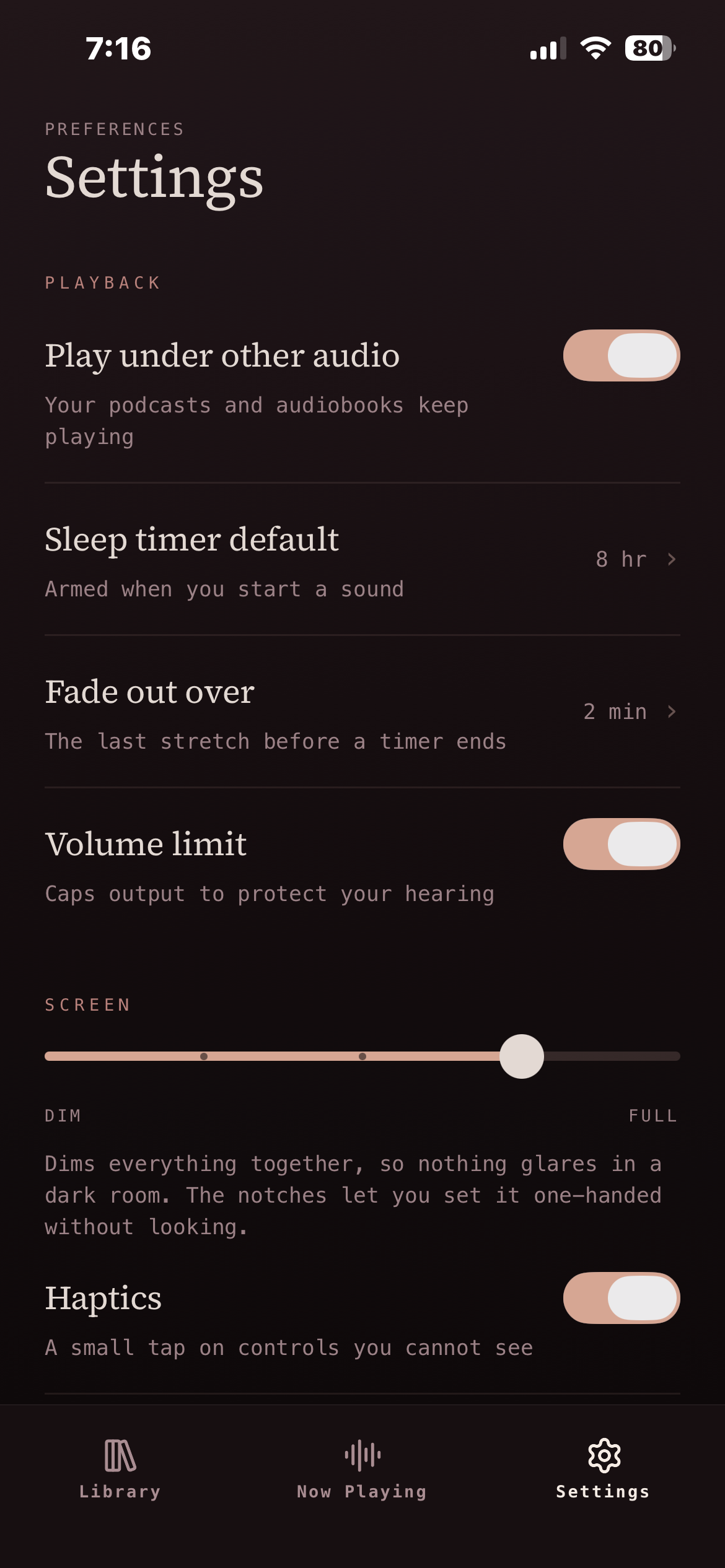
A brightness dial that dims the whole screen together rather than a second washed-out theme, and a volume limit that is on by default.
Graded, including where it goes against us
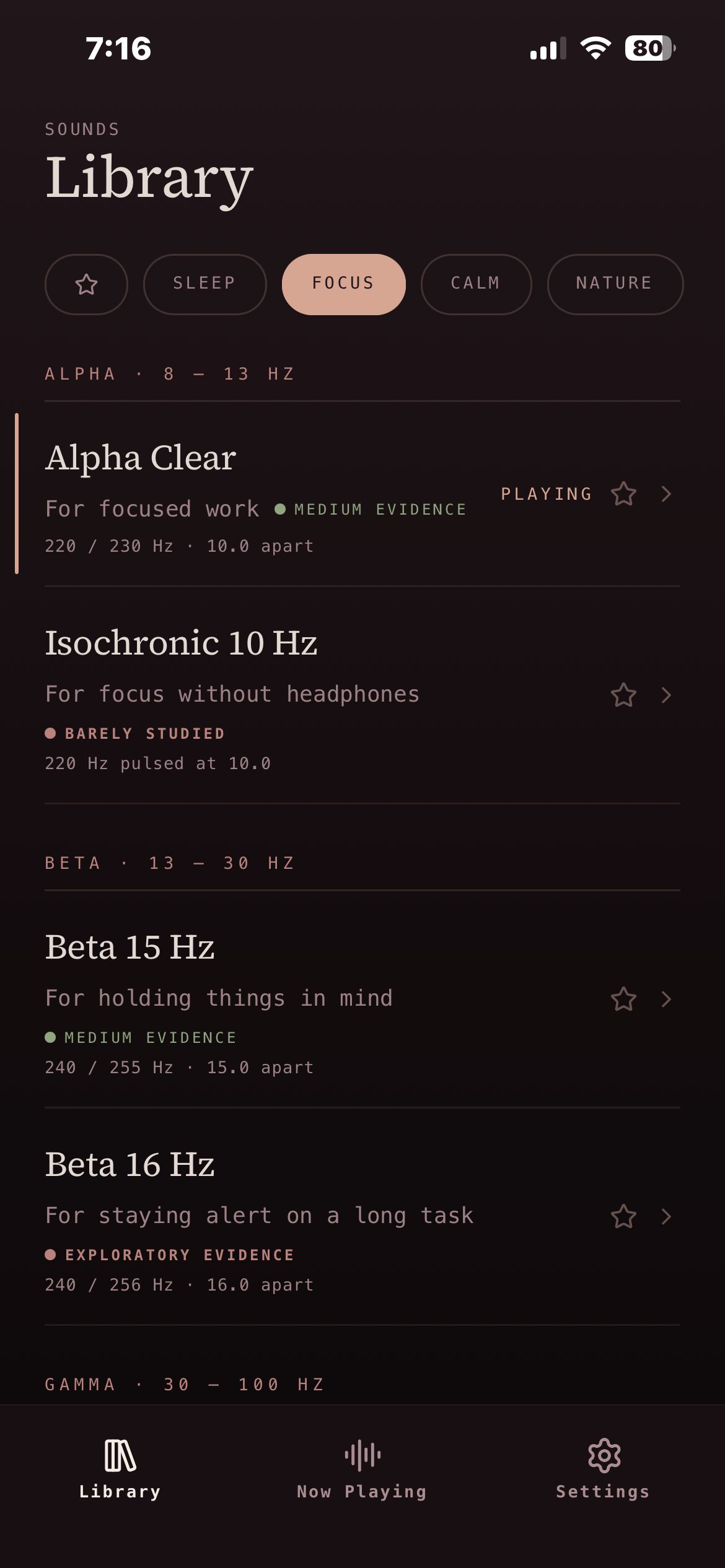
Every sound in the app carries the grade its evidence earns, shown on the sound itself rather than buried in a page nobody opens. Here is the whole scorecard.
- Noise masking Strong evidence Steady broadband sound raises the level at which a sudden noise wakes you. The least mystical thing in the app, and the best understood.
- Binaural beats Medium evidence A medium-sized pooled effect across 22 studies that disagree with each other a great deal. The app is named after these and still says that plainly.
- Nature sounds Medium evidence Reviews do find better sleep and lower stress, though they rarely separate the sound from lying still for twenty minutes.
- Isochronic tones Barely studied In the app because they work on a speaker, not because the research is strong. It is thin.
- Some beat rates Exploratory evidence 40 Hz, 16 Hz and 7 Hz rest on single pilots, and one was tested directly without producing the predicted change. Shipped, and labelled.
- Solfeggio and 432 Hz The benefit is not the tuning People do find these calming. The evidence points at the music, not the frequency it is tuned to, and one supporting pilot carries a corrigendum we cite.
What we will not do
Most of this category runs on claims nobody checks and billing nobody reads. Here is what Beatline commits to instead, and you can hold us to every line.
-
No free trial
Every billing-rage review in this category traces back to trial mechanics. You are charged when you decide to buy, not seven days after you forgot. A free tier and a clear price removes the whole complaint.
-
No countdowns, no fake scarcity
No limited offer, no expiring discount, no struck-through price. The annual plan costs less per month because a year is longer than a month, and that is the only argument we make for it.
-
Cancel in two taps, with no survey
Settings links straight to the Apple subscription page. No retention offer, no are-you-sure, no exit questionnaire.
-
Evidence that undercuts us, published anyway
The Science screen grades each kind of sound and cites the studies, including the review that found no support for entrainment and the trial where binaural beats made a task harder. Noise masking is the best-evidenced thing in the app; the solfeggio tones are the weakest, and it says so.
-
No medical claims
Our binaural beats app is not a medical device and nothing in it is medical advice. If sleep or anxiety is affecting your life, speak to a doctor rather than an app.
-
Nothing collected about you
No account, no analytics, no advertising identifiers, no microphone. Purchases go through Apple and RevenueCat, and that is the only data that ever leaves the phone.
Questions
Do I need headphones?
For binaural beats, yes. The effect is built from two tones, one in each ear, and on a speaker they blend in the air before they reach you. The app detects your output and only warns you when it genuinely applies. Isochronic tones, all the noise colours and the nature recordings work on a speaker.
What do I get for free?
Four soundscapes, one each for sleep, focus, calm and nature, with no time limit, no advertising and no account. The full frequency readout works on them too.
What does the subscription add?
The full library, custom frequency control, the sleep timer, and playing underneath podcasts and audiobooks. Monthly, annual, or a one-off lifetime unlock offered from day one rather than dangled after you subscribe.
Does any of this actually work?
It depends which part. Noise masking is well evidenced and the least mystical thing in the app. Binaural beats show a medium-sized pooled effect across studies that disagree with each other a great deal. The solfeggio frequencies have almost nothing behind the tuning specifically. The Science screen says all of this with citations, including the parts that do not flatter us.
Does it work offline?
Yes. The binaural beats are generated on the device and the recordings ship inside the app, so nothing needs a connection. Offline is not a paid feature here, because there is nothing to stream.
How do I cancel?
Settings, then Cancel subscription, which opens the Apple subscription page directly. Refunds are handled by Apple, because Apple takes the payment. See Support.
What do you collect about me?
Nothing. There is no account to create and no analytics in the app. If you buy something, Apple and RevenueCat handle the transaction and receive an anonymous identifier, never your name or email, because the app never has them. See Privacy.